
This week, I'm looking at narratives. In all the reading I did, there were certain key questions that came up; things like "Are (all) games narrative?", "Do games need narratives?", and "How can narratives be interactive?". These questions mostly seemed to end up unanswered or answered in unsatisfactory ways.
To look at the relationship between games and narratives, I'm going to look at a couple of extremes. First, is Tetris. Tetris has no narrative. There's no story telling you why you need to move these blocks around and make lines disappear and there's nothing to recount to people outside of the game (except maybe a particularly high score) as no one wants to hear exactly where you put the L-shaped block or whatever. So this seems to easily answer the question of whether games need narratives. But then what happens when games become more complex? If you removed all the story and characterisation and description from even a games as simple as Doom (walk around, shoot things, occasionally solve simple puzzles), what would be the point? The enjoyment of Tetris is in quick and logical thinking, whereas in Doom, it's being able to shoot various monsters. Though for this, you don't need an in-depth story.
To go to the other extreme, you can look at a game like Zork. Without any narrative, a text-only game like Zork becomes utterly pointless. The game relies on description for everything. But the narrative is still incomplete, your character is never described and the motives behind your "adventures" are never given. So even in a game that needs narrative, this can be incomplete.
Of course, there are more modern games where the narrative really is everything. Games like the Final Fantasy series are all about the story and because of this become much less of a game and more like a film where you push buttons occasionally (something I've mentioned before when comparing Final Fantasy X to Kingdom Hearts). There are other games where the narrative is more flexible. The story is defined and so are certain events, but things like the sequence of events and how certain tasks are carried out can differ from player to player. Most games will have only one ending/way of "winning", whereas games like Fable or Knights of the Old Republic are much more affected by the player.
Then there's games like The Sims, which are as open as possible. Instead of defining a story and making the player try to complete that story, the game developers create a world and give the player the tools with which to create their own stories.
Games like The Sims highlight how narratives in games are different to those in film or literature. In the latter, the writer controls everything and the viewer/reader is passive. They are told the story and that is that. In game narratives, the writer builds a world. They then choose their control over the "history" of the world. Whether everything is prescribed (like in Final Fantasy) or whether everything is open (like in The Sims). The player then dictates
how they experience this history. In a fully prescribed history, every player will have the same story, but it will be tempered by how difficult it was for them to discover. In an unprescribed history, each player will have their own history, but there will always be common elements as they are all in the same created world.
The problem with most analyses of game narratives is that they're compared to standard narratives of film or literature. They try to see the writer as active and the reader/player as only passive. The control the player has over their experience confounds this view. Much better is to see the player as experiencing the story in a "writerly" fashion. The game's creators/writers have put the story to them, but it is up to the player to give the story meaning and to create their own experience.
Imagine a game as a series of books. You can read these books in any order but parts of certain books rely on other books. So, you can read the books detailing certain events at any time you like, but you need to first read the book that explains who the characters are and why they do certain things (or maybe you don't, such as in Zork). Some of the books you could skip completely as they aren't needed for you to know the main plot, but maybe they are of interest because they reveal extra details about the characters or they could simply be about something enjoyable. Others would be major books that tell of major events that would result in a very boring story otherwise. Imagine the story of Star Wars as this series of books. You can skip the books where Obi-Wan uses his Jedi powers to influence the Stormtroopers or where he cuts off the arm of the alien in the bar as, while they are important, you can know the story without them. In contrast, you can't skip the book where Luke destroys the Death Star, otherwise there's no (major) ending to the story.
So, once again, the questions I began with have gone unanswered. Games can be narrative, but they don't need to be. More important is whether players want them to be (Tetris could have a story, but I doubt anyone would want to read it). Game narratives can be interactive because they're not the same as films or books. Just as a "writerly" view of reading means the reader defines the meaning of a piece, the player defines their experience of a game.
Showing posts with label sims. Show all posts
Showing posts with label sims. Show all posts
Saturday, 22 March 2008
Thursday, 14 February 2008
I are serious cat. This is serious game.
Some thoughts on Serious/Simulation gaming.
So, serious games are games intended solely for learning/training purposes. This raises a question; why are they used and why do they work? Looking at games in general, they all involve learning in some way. At the base level, you need to learn the various interfaces and control systems used in the game and (preferably) how to use these effectively. Then you need to learn the strategy level of a game. This is a broad level and depends on the game you are playing. In a game like Tetris, you simply need to learn how to get the most points and how to stay playing for as long as possible. In a more complex game, such as a real-time strategy or city management game, these strategies would be more complex and may seem counter-intuitive at times as complex games will not always offer a clear line of sight to your "end goal".
The question of why these games work can be answered by this look at games (meaning being able to play multiple games well, rather than just a specific game or a specific genre of games). The most effective way to be good at games is not to understand the "how" of playing a game, but to understand the "why" of playing the game. This means to understand the fundamental aspects of why what you do in a game works. This means you develop skills that can be applied elsewhere, rather than simply to one game.
This leads on to answering the question of why the games are used. While there are other concerns, such as cost or the fact that "on the job" training would be impossible (or irresponsible), the main reason should be this disambiguation of skills. You don't need to train people to push a button (or if you do, you don't need an expensive simulation to do it), you need to train people to understand why they are pushing a button. This is also useful as otherwise you'd end up with people trained to be good at simulations rather than real life situations.
This reminds me a lot of the training games in Ender's game, where the recruits play games in order to develop strategic skills. These games are basically simulations of the battles they would ultimately end up fighting, but they are still very unlike the battles themselves. In the end, the students end up playing a "game" that turns out to not be a simulation. (Interestingly, the Wikipedia article on America's Army compares it to these games).
This brings me to simulation games. Mostly it brings me to various games made by Will Wright (such as SimCity and The Sims). It makes me think of how, often the most effective games as learning tools, are ones where you don't realise you're meant to be learning. This took me back to a talk by Will Wright at TED, where he talks about designing games that are "learning toys" and his upcoming game, "Spore". In these games, the object is not to "win", as the games are open-ended (much like Tetris), but instead focuses on "not losing" for as long as possible.
So, serious games are games intended solely for learning/training purposes. This raises a question; why are they used and why do they work? Looking at games in general, they all involve learning in some way. At the base level, you need to learn the various interfaces and control systems used in the game and (preferably) how to use these effectively. Then you need to learn the strategy level of a game. This is a broad level and depends on the game you are playing. In a game like Tetris, you simply need to learn how to get the most points and how to stay playing for as long as possible. In a more complex game, such as a real-time strategy or city management game, these strategies would be more complex and may seem counter-intuitive at times as complex games will not always offer a clear line of sight to your "end goal".
The question of why these games work can be answered by this look at games (meaning being able to play multiple games well, rather than just a specific game or a specific genre of games). The most effective way to be good at games is not to understand the "how" of playing a game, but to understand the "why" of playing the game. This means to understand the fundamental aspects of why what you do in a game works. This means you develop skills that can be applied elsewhere, rather than simply to one game.
This leads on to answering the question of why the games are used. While there are other concerns, such as cost or the fact that "on the job" training would be impossible (or irresponsible), the main reason should be this disambiguation of skills. You don't need to train people to push a button (or if you do, you don't need an expensive simulation to do it), you need to train people to understand why they are pushing a button. This is also useful as otherwise you'd end up with people trained to be good at simulations rather than real life situations.
This reminds me a lot of the training games in Ender's game, where the recruits play games in order to develop strategic skills. These games are basically simulations of the battles they would ultimately end up fighting, but they are still very unlike the battles themselves. In the end, the students end up playing a "game" that turns out to not be a simulation. (Interestingly, the Wikipedia article on America's Army compares it to these games).
This brings me to simulation games. Mostly it brings me to various games made by Will Wright (such as SimCity and The Sims). It makes me think of how, often the most effective games as learning tools, are ones where you don't realise you're meant to be learning. This took me back to a talk by Will Wright at TED, where he talks about designing games that are "learning toys" and his upcoming game, "Spore". In these games, the object is not to "win", as the games are open-ended (much like Tetris), but instead focuses on "not losing" for as long as possible.

Friday, 8 February 2008
31/01/08 - 07/02/08
Games I've been playing this week:
So, this week I borrowed a Nintendo DS (not the lite, we're not that posh) from the IOCT, along with a couple of games.

Brain Age: Quite addictive, especially Sudoku (which I'd previously never played before). It can get quite frustrating though, such as when you write the correct answer and it misreads it and marks you down! I think I got my brain age down to 27 at one point, which was nice. Mostly it was just nice to work on my mental maths for the first time in ages.
 The Sims 2: I was rather confused by this game. I've played the first Sims game and I was expecting a similar thing, where I'd build a house and fill it with people and try to keep them happy. Instead I was thrown into what seemed very much like an RPG, where I had to collect objects and complete mission goals. Other than the fact that I had some sort of relationship with other Sims and I could move furniture around, there didn't seem to be much in common with the normal Sims game. Building things and putting things in them has always been my favourite part of sim/management games, so this game was fairly disappointing (yes, I'm the guy who makes sure he buys enough benches to be put against all the walls in Theme Hospital).
So, this week I borrowed a Nintendo DS (not the lite, we're not that posh) from the IOCT, along with a couple of games.
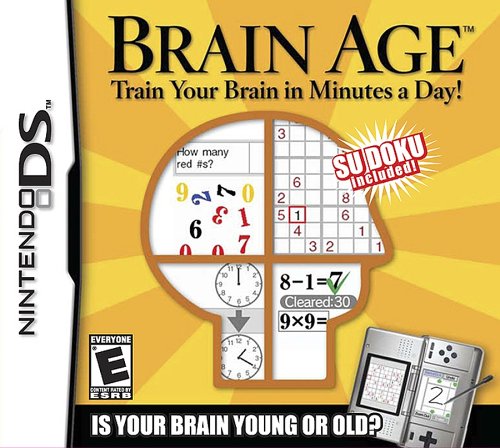
Brain Age: Quite addictive, especially Sudoku (which I'd previously never played before). It can get quite frustrating though, such as when you write the correct answer and it misreads it and marks you down! I think I got my brain age down to 27 at one point, which was nice. Mostly it was just nice to work on my mental maths for the first time in ages.
 The Sims 2: I was rather confused by this game. I've played the first Sims game and I was expecting a similar thing, where I'd build a house and fill it with people and try to keep them happy. Instead I was thrown into what seemed very much like an RPG, where I had to collect objects and complete mission goals. Other than the fact that I had some sort of relationship with other Sims and I could move furniture around, there didn't seem to be much in common with the normal Sims game. Building things and putting things in them has always been my favourite part of sim/management games, so this game was fairly disappointing (yes, I'm the guy who makes sure he buys enough benches to be put against all the walls in Theme Hospital).
Subscribe to:
Posts (Atom)
